

What Does Intelligence Have To Do With Brain Size Or Functioning?
In this article I'll argue that the research on race, brain size, and IQ, constitutes a significant line of prove supporting a genetic model of racial IQ differences. But before turning directly to that topic we need to differentiate betwixt research on phrenology and research on brain size. Phrenology was largely concerned with predicting people's psychological traits using the bumps and curves of their skull. Empirically this has been demonstrated to be invalid (Jones et al., 2018).
By contrast, meta-analyses consistently show that brain size is positively correlated with IQ.
| Commendation | K | Due north | R |
| Rushton and Ankey (2009) | 28 | i,389 | 0.38 |
| Rushton and Ankey (2009) | 59 | 63,405 | 0.ii |
| McDaniel (2005) | 37 | 1,530 | 0.33 |
| Gignac et al. (2003) | 12 | 858 | 0.43 |
| Pietschnig et al. (2015) | 88 | 8,036 | 0.24 |
Moreover, a correlation of 0.19 between brain volume and fluid intelligence was constitute in a pre-registered analysis of 13,608 Brits (Nave et al, 2018). The fact that this report was pre-registered implies that publication bias cannot explain the finding.
Inquiry besides shows that this correlation persists within families meaning it is not the result of brain size being a proxy for socio-economical status or any other variable shared by members of the same family unit.
| Citation | Correlation | N |
| Lee et al. (2019) | 0.18 | 381 |
| Gignac et al. (2003) | 0.15 | 64 |
| Schoenemann et al. (2000) | -0.07 | 72 |
| Jensen (1994) | 0.13 | 143 |
| Jensen et al. (1994) | 0.12 | one,936 |
| Jensen et al. (1994) | -0.04 | i,377 |
| Lee et al. (2019) | 0.xix | 1,349 |
| N-Weighted Mean | 0.10 | 5,322 |
The psychologist and noted opponent of hereditarianism Richard Nisbett has denied this. He wrote on page 219 of his popular 2009 volume "Intelligence and How to Become It"": "The correlation found inside the white population probably does not betoken that greater brain size causes higher IQ. Within a given family, the sibling with the larger brain has no higher IQ on average than the sibling with the smaller brain". To substantiate this claim Nisbett cited Schoenemann's study of 72 subjects, a sample size too pocket-sized to be worth much, and just ignored the rest of the research literature.
The fact that brain size too predicts intelligence in non-human species should make the states even more than confident that this correlation reflects something causal.
| Citation | Animal | Correlation |
| Hamilton (1935) | Rats | 0.35 |
| Anderson (1993) | Rats | 0.48 |
| Deaner et al. (2007) | Non-human Primates | 0.65 |
| Hopkins et al. (2019) | Chimpanzees | 0.23 |
Still further prove comes from the fact that research consistently finds encephalon size to be genetically, rather than merely phenotypically, correlated with intelligence.
| Commendation | Finding |
| Lee et al. (2019) | This study of over 10,000 Brits institute a genetic correlation of 0.29 between IQ and encephalon volume. |
| Posthuma et al. (2002) | The genetic correlations betwixt IQ and brain volume accounts for the entirety of the phenotypic correlation between IQ and encephalon volume (n=80) |
| Pennington et al. (2000) | This study constitute a genetic correlation of .48 between brain volume and IQ. This genetic correlation accounted for 80% of the phenotypic correlation betwixt brain volume and IQ (northward=96) |
| Posthuma et al. (2003) | Beyond 3 measures of brain volume and four measures of cognitive power, the average genetic correlation betwixt brain book and ability was 0.xx while the average ecology correlation was -0.09 (n=688). |
| Van Leeuwen et al. (2009) | Beyond four measures of cognitive ability, the average correlation between brain book and cognitive ability was .29 while the average ecology correlation was 0.05 (n=224) |
| Betjemann et al. (2010) | Brain volume genetically correlates at 0.28 (ns) with Verbal IQ and 0.71 with Performance IQ. |
| Elliot et al. (2018) | This meta-analysis found that people with college pedagogy based polygenic scores likewise accept larger brains (r=0.06, thousand=4, north=vii,965). |
| Hagenaars et al. (2016) | Didactics based polygenic scores genetically correlated at 0.44 with intercranial volume in a sample of 111,114 brits. Specific cognitive abilities exhibited weaker genetic correlations. |
| Jansen et al. (2020) | This study estimated the genetic correlation between brain volume and intelligence to be 0.24 (n=269,867) |
In that location also may exist a correlation between an IQ subtest's g loading and its correlation with IQ. I say "may" considering we don't have much evidence on this question and the conclusion that said limited evidence will lead us to depends on whether we include in our analysis a written report which is a statistical outliers from the rest.

Regardless, the testify suggests that there is a pretty robust relationship betwixt IQ and brain size. To counter this claim, various arguments have been offered.
For instance, a common argument goes like this: men have bigger brains than women, just men are not smarter than women. Therefore, larger brains must not cause people to be smarter.
Of form, brain size only explains a fraction of the total variance in IQ and then ii groups tin be of equal intelligence with unequal encephalon size then long as the smaller brained group is sufficiently advantaged by some other factor, For case, some autopsy information has suggested that women's neurons are more than tightly packed than men'due south are. Thus, men and women may have the aforementioned neuron count fifty-fifty though they have different brain sizes (Lipton 2002 page 193). Or, at that place may be some other divergence that we, or at least I, don't know about. Either way, this is not a very compelling statement.
It'due south likewise worth noting that the assumption behind that argument, that men and women are equally intelligent, may not be true. Depending on which meta-assay or large report yous look at, you lot can find that men have higher IQs than women or that the sexes have equal IQ (e.g. Jackson and Rushton 2006, Flynn and Case 2011, and Irwing and Lynn 2005). If there is an IQ advantage for men, then this argument confronting brain size and IQ becomes even weaker.
Another argument sometimes made is that people with megalencephaly, a neurological disease, have huge brains but practise not have high IQs. Therefore, large brains must not cause high IQ. This argument has been made by some well known academics (Pietschnig et al 2015), and I think information technology's about every bit compelling as saying that bigger hearts don't pump more than blood considering people with enlarged hearts pump less blood than average. Both lines of reasoning are flawed for the same reason: people with rare conditions like these accept abnormally functioning biology'southward and so should not exist used as a model for how human biology normally functions. In the example of people with abnormally enlarged brains, whatever tension between this and encephalon size research tin can be eliminated by noting that they we have no reason to retrieve that the brain areas which are involved in intelligence are especially big and normally functioning in such people.
With the link between brain size and intelligence established, permit'southward turn to race. In 1994 Harvey et al preformed the outset report comparing the brains of different racial groups using MRI technology to measure encephalon size. They confirmed previous findings: Blacks have smaller brains than Whites. The same finding was reproduced by Jones et al (1994), though the difference wasn't statistically pregnant. Chee et al (2010) found that Whites have larger brains than Eastward Asians. Finally, Tang et al (2010) found that Whites have longer brains than East Asians while Eastward Asians have wider and taller brains than Whites. Unfortunately, all of these studies have very limited sample sizes and, with the exception of Tang et al, failed to command for differences in the sexual composition of racial samples. Thus, if, for instance, the Black samples had a higher female to male ratio than the White samples then, because men have larger brains than women, Black'southward brain size will exist depressed relative to Whites.
But these findings represent well with what older studies measuring skull book found. Beals (1984) aggregated data on roughly twenty,000 subjects from by studies which showed East Asians having the largest skulls followed by Whites followed past Blacks.
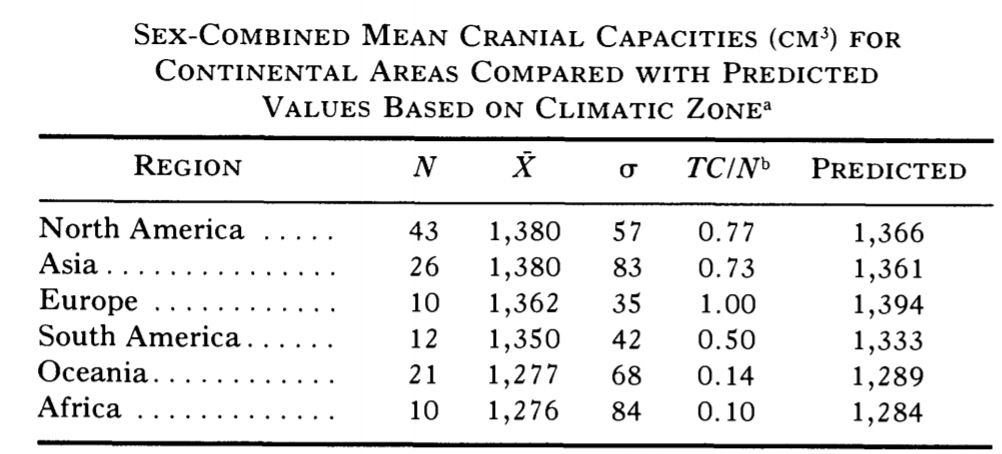
Beals (1984)
A famous critique of this line of piece of work was launched by Gould (1981) who argued that researchers involved in this work, most famously the 19th century anthropologist Samuel Morton, unconsciously allowed their racist views to cause them to back material more than tightly into White skulls than into Black skulls and thus inflate the racial deviation. Gould also accused Morton of excluding data from his tables that increased the racial disparity in brain size in favor of Whites. Both of these accusations have been shown to be false. Morton's skulls were re-examined by modernistic researchers who reproduced Morton'south results, and the data that Gould accused Morton of omitting was actually included by Morton in the same book that Gould cited, just on unlike pages (Lewis et al. 2011).
Of course, a third way to measure brain size is to rip a brain out of a skull during an dissection and measure its volume. Dissection work done in the late 2000'southward found that Whites averaged the largest brains, followed by, East Asians, followed by Blacks (Rushton and Ankney, 2009). This same method has been used to confirm the Back/White/Asian brain size disparity for well over a century:

Tobias (1970) offered a highly influential critique of this literature which in turn was cited and popularized by Gould. In it, Tobias argued that comparisons of the brain size of racial groups based on autopsies were invalid because they failed to command for a wide variety of variables that could impact brain size. Said variables included, but were non limited to, age of expiry, nutritional intake early on in life, occupational status, cause of death, time of death, temperature the encephalon was kept in after death, and the verbal place the brain was cutting from the spinal cord.
Some of these controls would manifestly exist misleading because of the correlation betwixt things Tobias wanted held abiding and intelligence (occupational condition for instance) and then holding them constant would involve holding a function of the racial IQ gap constant. Some of the proposed controls also had zippo to do with measuring encephalon size but rather had a plausible connexion with impacting encephalon size (eastward.yard. early life nutrition). Such controls would not exist appropriate when request whether, equally opposed to why, racial groups differ in hateful encephalon size.
That being said, some of these criticisms are more plausible. However, there is no reason to think that whatsoever of these problems would bias the results in favor of i race or some other. And random error introduced can be overcome via aggregation. Thus, Rushton (1995) combined all the data from the studies Tobias critiqued and plant the now familiar pattern of Whites having the largest brains, followed past Asians, followed by Blacks. Tobias tin can exist said to have pointed out that racial bias in measurement is logically possible, merely he did cypher to justify the conventionalities that this was actually taking place to a significant degree.
A 4th way to measure encephalon size is to estimate information technology based on external head size. The major advantage to this method is that researchers can cheaply measure the brain sizes of large and representative samples of living people. One of the largest of these studies was Rushton (1992) which had a sample of 6,325 and found that Whites had the largest brains, followed by East Asians, followed by Blacks.
Rushton (1997) analyzed data on 17,000 white Americans, 19,000 black Americans, and 100 Asian Americans taken from The Collaborative Perinatal Project, a longitudinal report which followed subjects from birth to seven years of age. This information gear up also showed whites having the largest brains, east Asians having the largest relative to trunk size, and blacks having the smallest brains in both accented and relative terms.
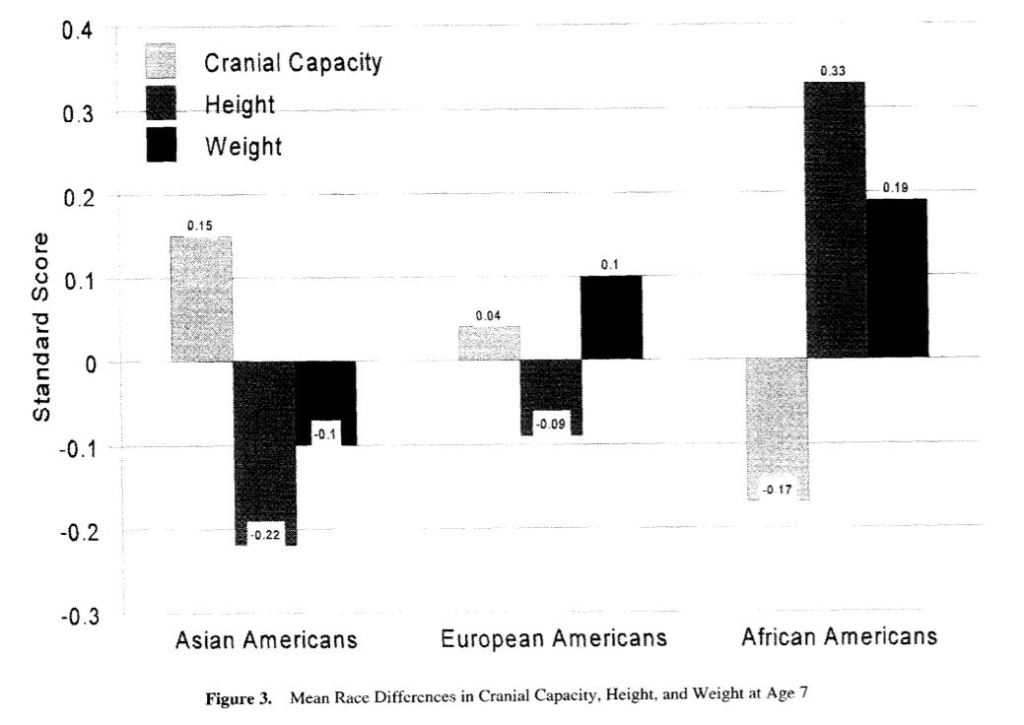
Rushton combined information from these sources to produce the following graph showing consequent racial differences in relative brain size from nativity to adulthood.
These differences are nowadays amidst new borns and even unborn fetuses. Such has been demonstrated numerous times. (Several of these newspaper were initially compiled in Kirkegaard (2018)).
| Citation | Finding |
| Rushton (1997) | At nascency, infants exhibited an Asian>White>Black pattern in brain size (n-35,859). |
| Thomas et al. (2000) | White and Hispanic neonates had head circumferences 0.4cm larger than black neonates (northward=27,229) |
| Mujugira et al. (2013) | Mothers of infants with large heads were more than likely to be white than were mothers of infants with averaged sized heads (82% vs 74%, n=21,500) |
| Germaine et al. (2015) | White fetuses are shown to take larger heads than black, hispanic, and asian, fetuses at various stages of gestational evolution (n=2,334) |
| Schultz (1922) | Fetuses exhibited a White>Black pattern in brain instance size (n=623). |
| Ho et al. (1981) | Due to having less time in gestation, blackness new borns were foudn to have lower brain weights than white new borns (n=782). |
The fact that racial differences in brain size are realized at such early on stages of development constitutes the first line of evidence favoring the view that such brain size differences are partly acquired by genes rather than but environments.
Several studies take shown that mulattoes have an average brain size in betwixt that of Blacks and Whites (Pearl, 1934; Edible bean, 1906). This finding has been established on multiple occasions and is what a hereditarian hypothesis would predict since mulattoes are half White and half Black genetically speaking.
Furthermore, many traits which tend to co-evolve with larger brains too differ racially in a way that mirrors the torso size adjusted brain size pattern. Rushton and Rushton (2003) looked at 41 anatomical features which 3 textbooks on human evolution identified as tending to co-evolve in the hominid line with larger brains.


For case, larger pelvic size tends to co-evolve with brain size then that mothers tin requite birth to larger brained infants. The pattern of the distribution of such traits by race fit what we would await given evolved racial differences in brain size at a rate far greater than what random gamble would probable produce.
Finally, at that place is some testify that the races evolved unlike brain sizes in response to climate. Specifically, various studies have found that a population's brain size correlates with climate related variables. For instance, Pearce and Dunbar (2011)'s data ready produces a correlation of .74 between a population'south brain size and its breadth. Similarly, Ash and Gallup (2007) institute a correlation of .48 between the size of 109 fossilized human being skulls and the latitude at which they were found. Further all the same, Bailey and Geary (2009) analyzed 175 skulls ranging in age from 10,000 years former to 1.9 meg years old and found a correlation of -.41 between encephalon size and winter temperature and -.61 between size and breadth (larger brains were establish in areas more distant from the equator).
Lynn (2015) used Smith and Beals information set of 20,000 skulls from 122 populations to estimate that roughly thirty% of the African-European IQ gap tin be statistically deemed for past brain size differences. By dissimilarity, encephalon size differences would actually predict an Asian-European IQ gap 35% larger than the one that really exists. Thus, brain size is probably one of many factors which account for racial intelligence differences.
The best known remaining counter to the claim that racial groups differ in brain size due to genes comes from Boas (1912). Boas, who was a founder a modern cultural anthropology, looked at the American children of European immigrants and institute that their mean encephalon size was very different from that of their parents and more than like to the brain size of non-immigrant American children. This study has gone on to be widely cited and pointed to as the first scissure in the armor of genetic determinism.
However, in his analysis Boas neglected to business relationship for historic period differences betwixt groups and this distorted his conclusions. Sparks and Jantz (2002) re-analyzed Boas's data afterwards accounting for the age difference between parents and children and found that the brain size of immigrants and at that place children did non differ in whatsoever statistically significant way and the brain size of immigrant children did significantly differ from those of Americans. In fact, based on the correlations betwixt parent and children brain size, the heritability coefficient derived from Baos's own data is greater than fifty%. This is consistent with the conclusions of modern inquiry on the heritability of encephalon size (DeStefano et al., 2010).
Thus, when considering the evidence, objections, and counters to those objections, together we are justified in thinking that information on encephalon size constitutes a meaning line of testify favoring a genetic model of racial difference sin IQ.

What Does Intelligence Have To Do With Brain Size Or Functioning?,
Source: https://ideasanddata.wordpress.com/2021/02/13/race-iq-and-brain-size/
Posted by: drakeyousbaged1946.blogspot.com
0 Response to "What Does Intelligence Have To Do With Brain Size Or Functioning?"
Post a Comment